AI Is Changing Animation. Are You Ready for It?
Imagine having an idea for a character in the morning and being able to explore dozens of visual possibilities before lunch.
Imagine turning a rough concept into a storyboard faster, experimenting with different environments without starting everything from scratch, or using AI to handle repetitive parts of a creative workflow while you focus on storytelling and artistic decisions.
This is no longer just a futuristic idea.
Artificial intelligence is becoming part of the modern animation industry.
From concept development and storyboarding to 3D workflows, video generation, voice creation and post-production, AI tools are giving creative professionals new ways to work.
But there is an important question for anyone planning a career in animation:
Will AI replace animators, or will animators who know how to use AI become more valuable?
The answer lies in learning how to combine creative skills with technology.
For aspiring animation professionals, learning AI tools isn't about abandoning traditional animation skills. It is about adding another powerful skill to your creative toolkit.
How Is AI Changing the Animation Industry?
Animation has always evolved with technology.
The industry moved from hand-drawn animation to digital 2D workflows, then embraced 3D software, motion graphics, advanced VFX and increasingly sophisticated rendering technologies.
AI is the next major shift.
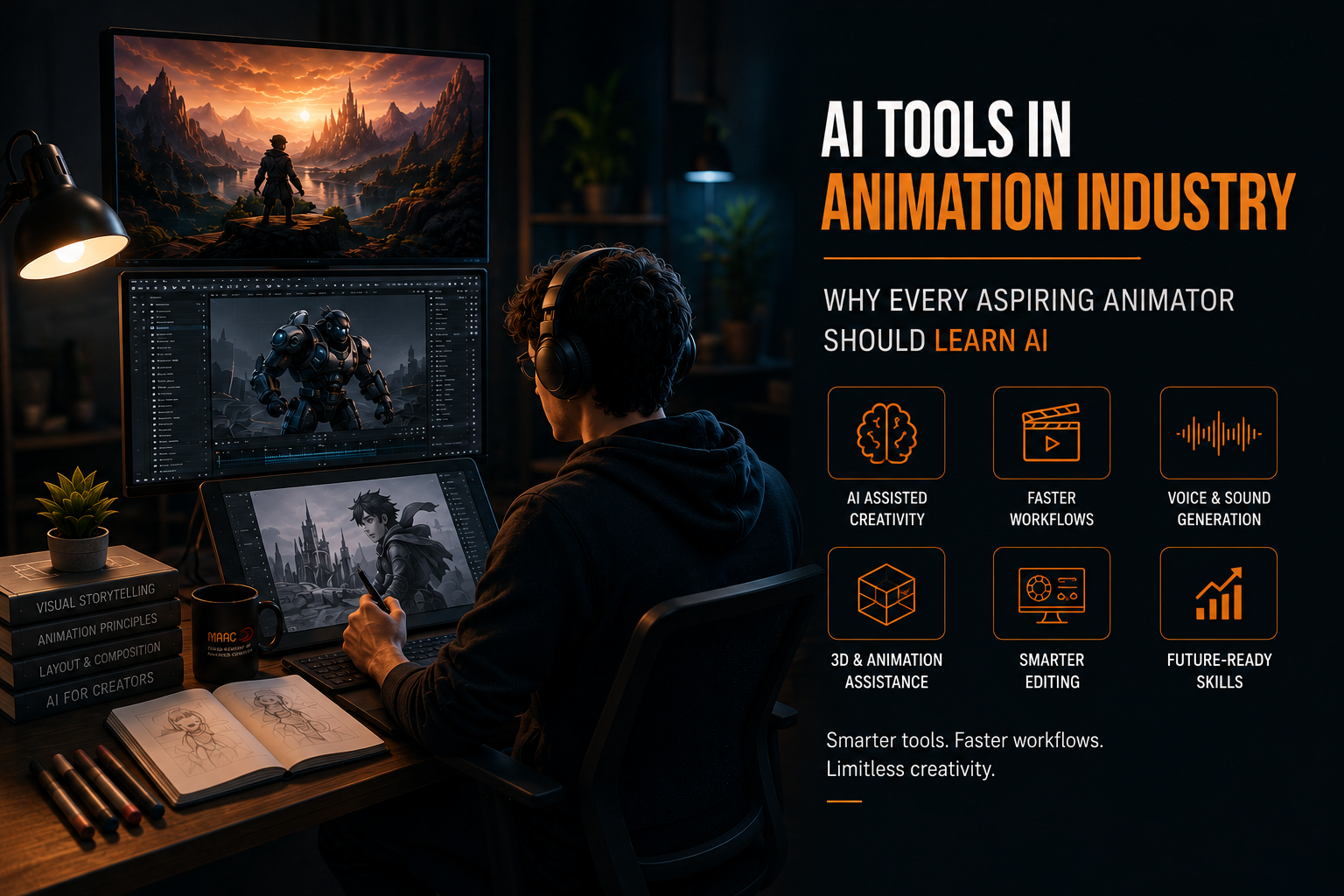
Today, AI can assist creators with several stages of production, including:
- Concept and idea generation
- Character exploration
- Environment development
- Storyboarding
- Image generation
- Video generation
- Voice and sound creation
- Animation assistance
- Editing and post-production
- Repetitive production tasks
This doesn't mean that a machine suddenly understands a story the way a human does.
Instead, AI can act as a creative assistant, helping artists explore possibilities and reduce the time spent on repetitive work.
The animator still needs to decide what the story should communicate, how a character should behave, what emotion a scene should create and whether the final result actually works.
And that human creative judgment matters.
Why Should Animators Learn AI Tools?
1. Create and Explore Ideas Faster
One of the biggest advantages of AI is speed.
An animator may have an idea for a futuristic city, fantasy character or cinematic environment but need hours to explore different visual directions.
AI tools can help generate initial visual concepts quickly.
That doesn't mean the first AI-generated image becomes the final artwork.
Instead, it can become a starting point for creative exploration.
Students can experiment with:
- Character appearances
- Colour and lighting ideas
- Environments
- Visual styles
- Composition
- Mood and atmosphere
This allows artists to explore more possibilities before committing to a final direction.
2. AI Can Speed Up the Pre-Production Process
Pre-production is one of the most important stages of animation.
Before animation begins, creators need to develop ideas, characters, environments, storyboards and visual references.
AI tools can assist with parts of this process.
For example, an animator can use AI-assisted workflows to explore storyboard concepts, generate visual references or communicate an idea to a team more quickly.
The result?
Less time spent struggling to communicate an idea and more time spent improving the idea itself.
3. Spend More Time on Creativity
Animation involves plenty of repetitive work.
Depending on the project, artists may spend significant amounts of time preparing assets, making variations, organising references or performing other production-related tasks.
When appropriate AI tools can assist with repetitive processes, artists can redirect more of their attention towards:
- Storytelling
- Character development
- Visual direction
- Acting and emotion
- Composition
- Creative problem-solving
AI should not remove creativity from animation.
Ideally, it should give creators more room to use it.
What Types of AI Tools Are Used in Animation?
The AI landscape is expanding quickly, and new tools appear regularly. Instead of focusing on one particular software, aspiring animators should understand the different categories of AI-powered tools.
AI Tools for Concept Art
Generative AI can help artists explore character concepts, environments, props and visual directions.
For students, this can be useful during the early stages of developing a project.
However, generated images should be treated as references or starting points rather than automatically considered finished professional artwork.
AI Tools for Storyboarding
Storyboarding is where a story starts becoming visual.
AI-assisted tools can help creators quickly explore different shots, compositions and visual ideas.
This can be especially useful when developing an early visual direction for a project.
But the most important skill remains understanding camera language, composition, storytelling and visual continuity.
Technology can generate possibilities.
The animator has to decide which possibility tells the story best.
AI Tools for 3D and Asset Creation
AI is also beginning to influence 3D workflows.
Depending on the software and workflow, AI can assist with aspects of:
- 3D asset creation
- Texture generation
- Material exploration
- Environment development
- Image-to-3D workflows
- Asset variations
For aspiring 3D artists, understanding these developments can help them adapt to increasingly technology-driven production environments.
AI Tools for Video and Animation
AI-powered video tools are evolving rapidly.
They can help creators experiment with motion, visual sequences and video concepts.
However, professional animation requires far more than generating a moving image.
Understanding timing, movement, character acting, cinematography and storytelling remains essential.
This is why learning animation fundamentals is still incredibly important.
Will AI Replace Animators?
This is probably the biggest question students have.
Will AI take animation jobs?
It is understandable to be concerned.
But looking at the history of creative industries, new technology often changes workflows rather than simply eliminating the need for skilled professionals.
Digital tools didn't eliminate the need for artists.
3D software didn't eliminate the need for animators.
Editing software didn't eliminate the need for editors.
Instead, professionals learned to work with new technologies.
AI is creating a similar shift.
The future animator may not simply be someone who knows how to animate.
They may be someone who understands:
Animation + Design + Storytelling + Technology + AI
That combination can make a creative professional more adaptable.
AI Skills Every Future Animator Should Develop
Learning AI does not mean you should ignore the fundamentals.
In fact, the opposite is true.
The stronger your creative foundation, the better you can use AI.
Aspiring animators should focus on developing:
Animation Fundamentals
Understand timing, spacing, movement, acting and visual storytelling.
Design Skills
Learn composition, colour, typography, visual hierarchy and design principles.
3D and VFX Knowledge
Understand how modern production pipelines work.
Prompting and AI Workflows
Learn how to communicate effectively with generative AI tools and integrate them into creative workflows.
Critical Thinking
Don't accept every AI-generated result.
Learn to identify what works, what doesn't and what needs improvement.
Human Creativity
This may become the most important skill of all.
AI can generate possibilities.
You bring the vision.
Why Should Animation Students Learn AI Now?
The animation industry is moving quickly.
Students entering the field several years from now may work in production environments that look very different from today's workflows.
That doesn't mean students need to master every new AI tool that appears.
They need to develop the ability to learn, experiment and adapt.
This is why AI education should ideally be combined with a strong foundation in animation, design, VFX, storytelling and production.
At MAAC Durgapur, students can work towards building creative and technical skills that prepare them for an evolving digital media industry.
The goal isn't simply to learn a piece of software.
The goal is to become a future-ready creative professional who can understand technology and use it creatively.
The Future Belongs to Adaptable Creators
The animation industry has never stayed still.
Every generation of artists has had to learn new tools, new technologies and new production methods.
AI is simply the latest chapter.
The important question isn't:
“Will AI change animation?”
It already is.
The better question is:
“Will you learn how to use it?”
For aspiring animators, learning AI alongside traditional creative skills can open the door to faster experimentation, smarter workflows and new ways of bringing ideas to life.
Because the future of animation may not belong to people who choose between creativity and technology.
It may belong to those who learn to combine both.
Frequently Asked Questions
1. What are AI tools in the animation industry?
AI tools in animation are software and technologies that use artificial intelligence to assist with creative and production processes such as concept development, storyboarding, asset creation, video generation, voice creation and post-production.
2. Why should animators learn AI?
Animators should learn AI to understand emerging production workflows, experiment with ideas faster and improve productivity while continuing to use their creative and technical skills.
3. Will AI replace animators?
AI is changing how animation is produced, but animation still requires storytelling, artistic direction, character performance, visual judgment and creative decision-making. Learning to work with AI can help animators adapt to changing workflows.
4. Do I need coding skills to learn AI animation tools?
Not necessarily. Many AI-powered creative tools can be used without advanced programming knowledge. However, understanding animation and design fundamentals is extremely valuable when working with AI.
5. Should animation students learn traditional animation before AI?
Students should build strong animation fundamentals while also becoming familiar with modern AI-assisted workflows. Understanding the principles behind animation helps creators evaluate and improve AI-assisted results.
6. Is AI useful for 3D animation?
Yes. AI is increasingly being incorporated into different parts of 3D workflows, including asset creation, texturing, material generation, concept development and other production processes.
Conclusion
AI is not simply another trend in the animation industry.
It represents a significant shift in how creative work can be planned, produced and refined.
For aspiring animators, the smartest approach isn't to fear the technology or depend entirely on it.
Learn the fundamentals. Learn the tools. Experiment with AI. Build your creative judgment.
Because tomorrow's successful animator may not be the person who knows the most tools.
It may be the person who knows how to use technology without losing the human creativity behind the story.
Ready to explore the future of animation? Start building your creative and technical skills with MAAC Durgapur.