3D Rendering vs 3D Lighting: Which Career Path Should You Choose?
If you want to learn 3D animation, you may eventually come across two important areas of the production pipeline: 3D lighting and 3D rendering.
At first, the two may sound similar. However, they have different purposes and require different skills. A lighting artist focuses on how a scene looks and feels, while rendering is the technical process of calculating the scene and producing the final image or sequence of frames.
So, when comparing 3D rendering vs 3D lighting, the real question isn't simply which one is better. It is about understanding which type of work matches your interests, strengths and long-term animation career goals.
Where Do Lighting and Rendering Fit in 3D Animation?
A finished 3D animation is created through several connected stages. A typical workflow can include:
Modeling → Texturing → Lighting → Animation → Rendering → Compositing
Each stage contributes something different to the final visual.
Modeling creates objects and characters, texturing adds surface details, lighting controls the visual atmosphere, animation creates movement, rendering calculates the final image, and compositing brings different visual elements together.
This is why understanding the wider production pipeline is useful when you want to learn 3D animation. 3D skills are not isolated from one another; they work together to create the final result.
What Is 3D Lighting?
3D lighting is the process of designing and placing lights within a digital scene so that characters, objects and environments look visually convincing and communicate the intended mood.
A 3D lighting artist may work with:
- Light direction
- Light intensity
- Colour
- Shadows
- Highlights
- Contrast
- Depth
- Atmosphere
- Mood
Lighting is not simply about making a scene brighter. It can influence what the audience notices, how a character is perceived and what emotion a scene communicates.
Why Is 3D Lighting Important?
Lighting is closely connected with visual storytelling. The same 3D character can communicate completely different emotions depending on how the scene is illuminated.
For example:
- Happiness: Bright, warm and soft lighting.
- Fear: Darkness, harsh shadows and limited visibility.
- Mystery: Silhouettes and controlled highlights.
- Luxury: Carefully placed highlights and refined contrast.
- Drama: Strong directional light and deep shadows.
- Fantasy: Colourful and atmospheric lighting.
If you enjoy cinema, photography, colour, mood and visual storytelling, developing skills as a 3D lighting artist could be an interesting career direction.
What Is 3D Rendering?
3D rendering is the process through which a computer calculates the information in a 3D scene and produces the final image or animation frames.
Once a scene contains models, materials, textures, lighting and camera information, a rendering system processes those elements to create the visual output.
Rendering can take into account:
- Geometry
- Materials
- Textures
- Lighting
- Shadows
- Reflections
- Camera information
- Atmospheric effects
A simple way to understand it is this: the 3D scene is the recipe, while rendering is the process of turning that recipe into the finished dish.
What Does a Rendering Artist Do?
A rendering artist works on the technical side of producing high-quality visual output from a 3D scene.
Depending on the production environment, rendering-related work can involve:
- Render settings
- Sampling
- Resolution
- Ray tracing
- Global illumination
- Reflections
- Shadows
- Render passes
- Render optimisation
One important challenge is balancing visual quality with efficiency. A visually impressive scene may not be practical if it takes an unreasonable amount of time to render.
This makes rendering particularly interesting for people who enjoy technology, visual realism, troubleshooting and technical optimisation.
3D Rendering vs 3D Lighting: What Is the Difference?
The easiest way to remember the difference is:
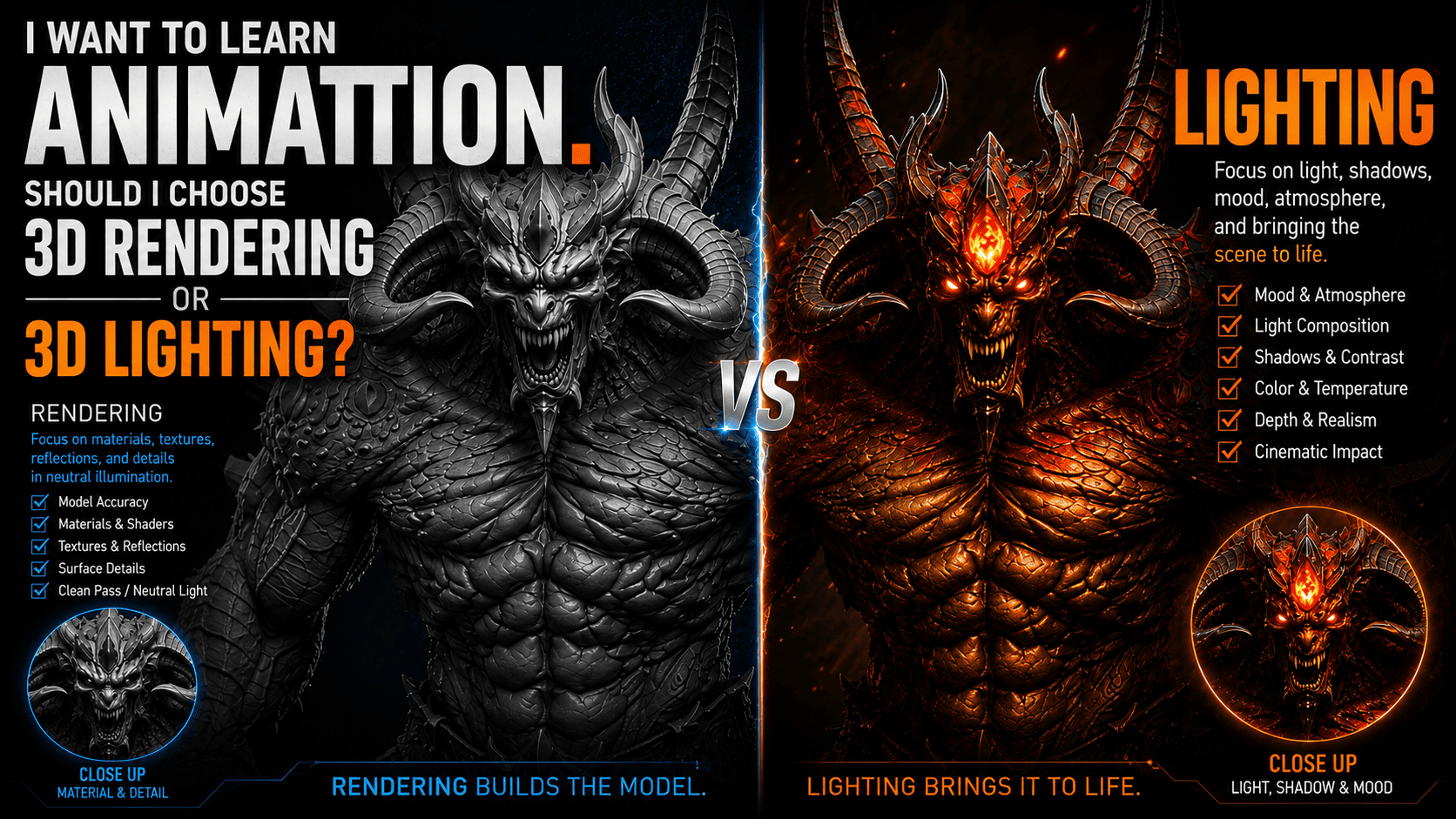
3D Lighting asks: How should the scene look and feel?
3D Rendering asks: How should the computer calculate and produce the final image?
3D Lighting 3D Rendering Focuses on light and visual mood Focuses on calculating the final image Strongly connected to visual storytelling Strongly connected to technical processing Works with shadows, colour and atmosphere Works with rendering settings, sampling and optimisation Requires visual judgement Requires technical problem-solving Helps define how the scene feels Produces the final visual output
However, the two areas are closely connected. Good lighting contributes to a beautiful render, while rendering technology is required to turn those lighting decisions into the final image.
Which Is More Creative: 3D Lighting or 3D Rendering?
There is no universal answer. The better choice depends on the kind of creator you are and the type of work you enjoy.
3D Lighting May Suit You If You:
- Love photography and cinematic visuals.
- Notice shadows and reflections.
- Enjoy experimenting with colour.
- Think about mood and atmosphere.
- Enjoy visual storytelling.
- Like making scenes look beautiful.
3D Rendering May Suit You If You:
- Enjoy technology and computers.
- Like understanding how things work.
- Are interested in visual realism.
- Enjoy solving technical problems.
- Like optimising workflows.
- Are curious about rendering engines.
- Enjoy the technical side of 3D production.
3D Lighting vs Rendering: Which Has Better Career Opportunities?
Instead of asking which specialisation has more scope, a better question is: Which skill can you become really good at?
3D lighting and rendering knowledge can be useful across several creative and digital production industries, including:
- Animation studios
- VFX studios
- Film and television
- Gaming
- Advertising
- Architectural visualisation
- Product visualisation
- Motion graphics
- Virtual production
Your role can also evolve as you gain experience. You may begin by developing expertise in one part of the pipeline and later move into another area.
If you are interested in developing professional 3D skills, explore the 3D animation programme at MAAC Durgapur.
Should You Learn 3D Animation Before 3D Lighting or Rendering?
You don't necessarily need to become an expert in every area before specialising, but understanding the broader 3D workflow can be extremely useful.
A lighting artist who understands materials and composition can make better lighting decisions. A rendering artist who understands lighting can better identify why a final image may not look as expected.
Learning the fundamentals of 3D animation can therefore help you understand how different parts of a production work together.
MAAC Durgapur's 3D animation programme covers the broader animation pipeline, including character modelling, rigging, cinematic storytelling and final rendering.
How VFX, Motion Graphics and 3D Connect
3D lighting and rendering are not limited to one type of production. Similar concepts can appear across animation, VFX, motion graphics, advertising, gaming and other digital media workflows.
If cinematic visual effects interest you, explore the VFX learning options at MAAC Durgapur.
If you enjoy typography, visual design, animation and moving graphics, motion graphics can be another creative direction to explore.
What About AI and 3D Animation?
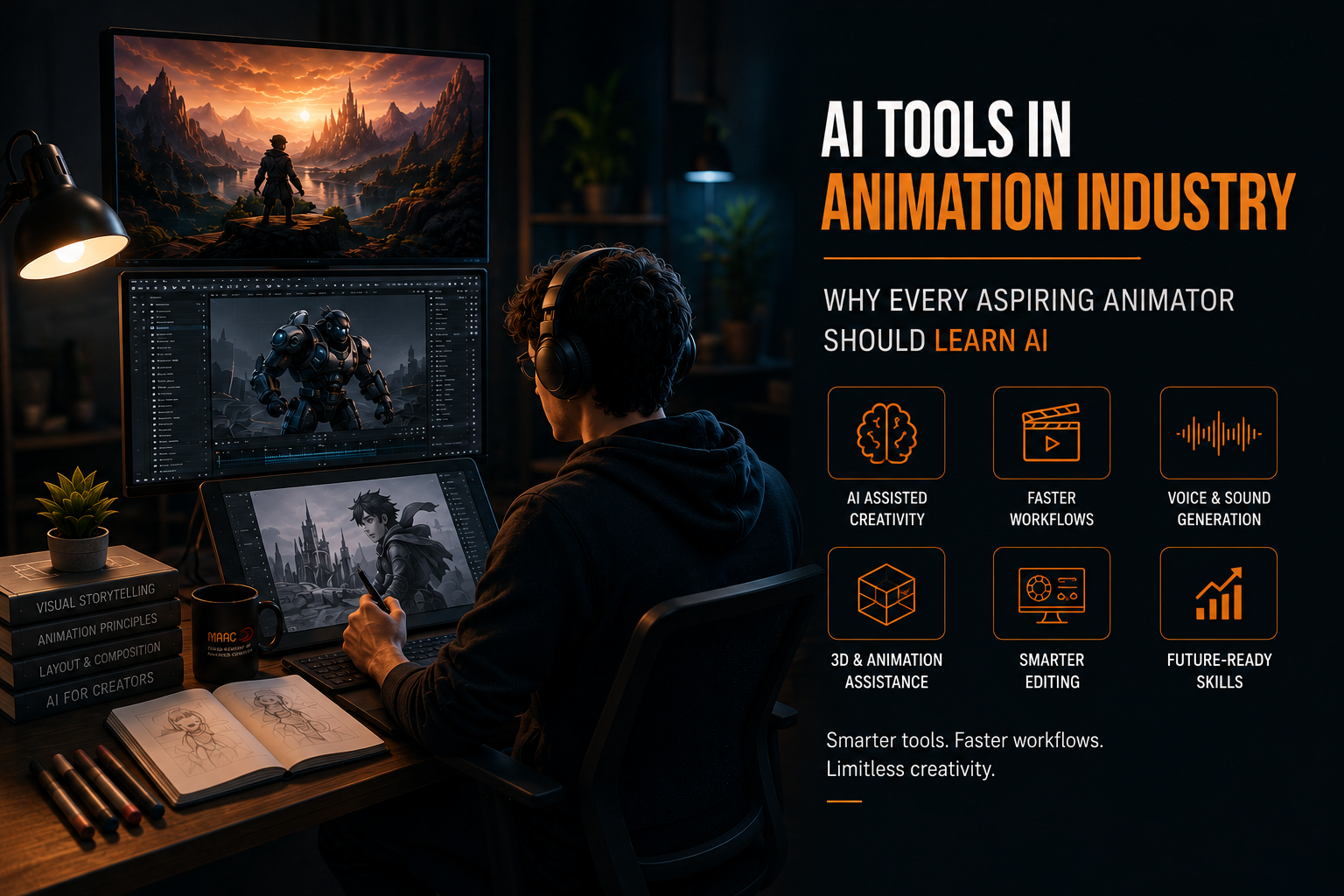
AI is becoming part of modern creative workflows. AI-assisted tools are being explored for areas such as concept development, texture creation, 3D asset generation, scene development, image generation, video generation and workflow automation.
However, AI does not remove the importance of fundamentals.
If you don't understand lighting, how will you judge whether AI-generated lighting works? If you don't understand composition, how will you evaluate the result? And if you don't understand rendering, how will you troubleshoot a technical problem?
The tools may change, but fundamental knowledge of light, colour, composition, materials, movement and visual storytelling remains valuable.
MAAC Durgapur also integrates modern AI creative tools into its creative education approach, including AI-powered workflows and creative applications.
Explore AI in animation and discover how AI and 3D skills can work together in modern creative production.
How Do You Choose Between 3D Lighting and 3D Rendering?
If you're unsure which direction to take, don't choose only because a job title sounds attractive.
Experiment with both.
- Create a simple 3D scene.
- Try different types of lighting.
- Change the colour temperature.
- Experiment with shadows and contrast.
- Adjust reflections and materials.
- Render the scene.
- Compare which part of the process you enjoyed most.
Ask yourself one simple question:
Which part made me lose track of time?
Your answer may tell you more about the right specialisation than simply reading a list of job titles.
Don't Just Learn Software — Learn the Fundamentals
When starting an animation journey, it is easy to focus on software. But software is only a tool.
Strong creative professionals also need to understand:
- Light
- Colour
- Composition
- Movement
- Storytelling
- Materials
- Visual language
- Production workflows
Once you understand the fundamentals, adapting to new software and emerging tools becomes easier.
Build Your Animation Career Step by Step
You don't have to know your final specialisation on your first day.
You may discover that you love lighting. You may enjoy rendering more than expected. Or you may eventually become interested in modelling, VFX, motion graphics or character animation.
That exploration is a normal part of learning.
At MAAC Durgapur, students can explore different areas of animation and digital media while developing creative and technical foundations relevant to today's evolving production environment.
If you're researching a career in animation, understanding different specialisations can help you make a more informed decision about your next step.
Frequently Asked Questions About 3D Rendering and 3D Lighting
Is 3D lighting part of animation?
Yes. Lighting is an important stage of the 3D production pipeline. It can influence mood, atmosphere, depth, visual focus and storytelling in an animated scene.
What is the difference between 3D lighting and 3D rendering?
3D lighting focuses on designing and placing light within a scene, while 3D rendering is the process of calculating the scene and producing the final image or animation frames.
Is 3D lighting difficult to learn?
Like any creative specialisation, it requires practice. Beginners can start with fundamental concepts such as light direction, intensity, colour, shadows, contrast and composition before moving to more advanced techniques.
Is 3D rendering a good career option?
Rendering knowledge can be valuable across animation, VFX, gaming, advertising, architectural visualisation and other digital production environments. Career opportunities depend on your overall skills, portfolio and specialisation.
Should I learn 3D lighting or rendering first?
Start by understanding the broader 3D workflow, then experiment with both areas. Your interests and the type of work you enjoy can help you decide which specialisation to explore further.
Can AI replace 3D lighting and rendering artists?
AI is changing parts of the 3D production workflow, but creative judgement, artistic direction and technical understanding remain important. Learning emerging technology alongside strong fundamentals can help future professionals adapt.
Final Thoughts
Animation isn't only about making things move. It is also about making people see, feel and remember something.
Lighting can make a character look heroic. A shadow can create suspense. A reflection can make a world feel real. Rendering can then turn those creative and technical decisions into the final image seen on screen.
So, if you're thinking about learning animation, don't worry about choosing the perfect specialisation immediately.
Try lighting. Try rendering. Try modelling. Try animation.
Eventually, you'll discover the area of 3D that feels less like studying and more like creating.